SEAN PILLOT DE CHENECEY
EXPLORING THE FUTURE: STRATEGIC FORESIGHT, INNOVATION, AND TRUST IN AN UNCERTAIN WORLD
L*OSMONAUTA #0005
/
15 min read
Sean is an expert in foresight, strategy, and innovation, with over twenty years of international consulting experience. He has supported major brands, institutions, and NGOs on projects ranging from strategic ethnography to future trend forecasting, helping organizations interpret the “Now/Next/Why.” Author of two successful books, he explores themes such as brand trust, authenticity, ethics, and how organizations can seize the opportunities emerging from social and technological change.
Interview :
SEAN PILLOT DE CHENECEY
Foresight, strategy, and innovation consultant
Okay, thank you so much for being here, so let’s start by asking you to tell us a bit about yourself. We usually ask everyone to share something about who they are and what’s brought them to where they are today.
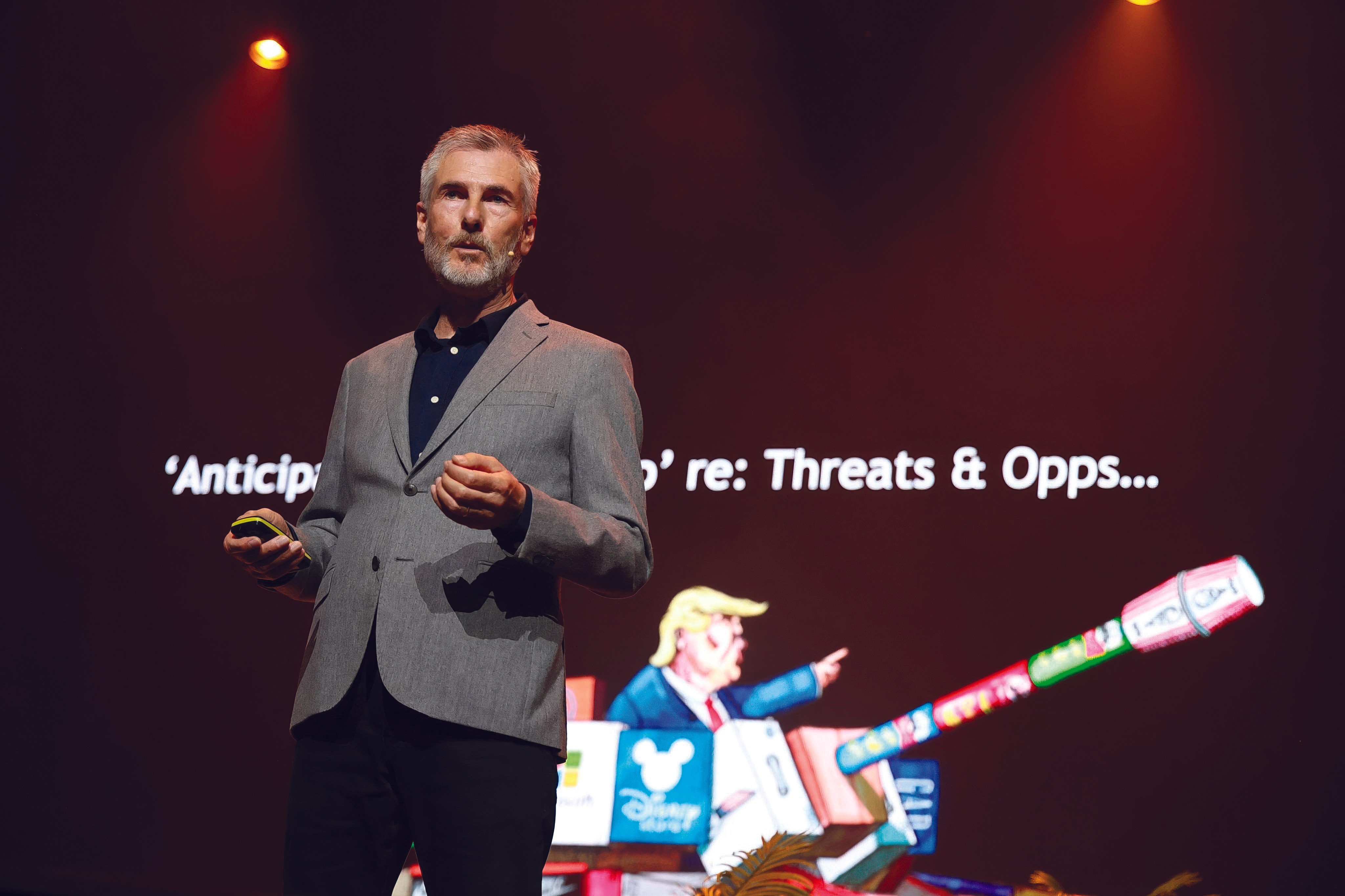
Sure, happy to. So, I’m a consultant based in Brighton, England. I’ve been working in futures and innovation research for around 30 years now. When I first entered the agency world, I focused primarily on youth culture and spent about a decade specializing in it, working both in the UK and the US. Then I shifted my focus more to forward-looking projects, so I’ve been in futures since about 2000. Right now, I’m also connected with the Copenhagen Institute for Future Studies as their UK partner. I’ve also been a public speaker and university lecturer since the 90’s, and I think that’s where you saw me recently - my talk at the Annual Leadership Summit, where I spoke about the idea of a ‘Chief Political Officer’, which I think is a really important new role.
Exactly. We actually read some of your articles first on the Copenhagen Institute website. How did your interest in this particular area of strategic business begin, and how did it develop?
As mentioned, I got involved in one of the first agencies specialising in youth culture in the UK, way back in the mid-80s. Back then, we were mainly focused on very forward-looking, opinion-forming activities, across pretty much every sector linked to a youth audience e.g. everything from fashion to banking, hospitality to music, and many more. As you’d expect, a lot of those efforts were, and maybe still are, about spotting trends, hence the amount of attention given to the area via trend agencies, who are endlessly seeking the ‘Next Big Thing’.
At the time, it was all based on visible trends. We’d do the classic thing of talking with opinion leaders and cutting-edge experts in relevant fields, focusing mainly on three or four cities e.g London, New York, Tokyo, Berlin. It sounds odd now, but back then, about 90% of trend research seemed to purely happen in these places, assuming trends would spread from there. That’s changed a lot now!
By the late 90s, I co-founded The Future Laboratory with my friends Martin and Chris. I left after a while, but they’ve built it into something amazing, and I really respect their work. Around the same time, I started my consultancy with my partner, Helen. She’d been at Central Saint Martins when it was the number one creative university to watch, then worked for years in fashion / design / trend forecasting, and then moved to the BBC to set up trend activity there before we set up our consultancy and we’ve worked on many, many projects together over the years.
We focus on multiple time-horizon projects, am I’m particularly interested in Horizon 3.
Around then, as mentioned I’d already been lecturing at universities for a few years, including Central Saint Martins and London College of Fashion, amongst others, and now I teach futures at Brighton University, which runs a really leading-edge course via their Business School. I also connected with the Copenhagen Institute of Futures Studies around that time. They invited me to give talks and write for their magazine, which was originally called Scenario, but is now renamed Farsight, and is an excellent futures publication.
That relationship has gone on for years alongside my independent consulting.
A few years ago, we started to do more with CIFS because they’re such a dynamic think tank and it’s a pleasure to work with their amazing team. We’ve recently wrapped up a project covering China, America, Saudi Arabia, South Korea, Mexico, and the UK. A multinational project that looked over different timescales and across numerous sectors, it was incredibly interesting.
You mentioned your work in academia. I believe universities often have a very design-based culture rooted in design thinking. So one of the questions is: what’s the difference between foresight-driven innovation and design thinking?
Sure. That’s a really important question. Basically, when talking about design thinking, which is frankly linked to most innovation practices, this is seen as focused on creating solutions for today’s world and the near future, so the exploration mainly looks at the present and the recent past. That’s generally where traditional design-led innovation happens. With foresight-driven innovation, a subject on which I also teach courses for the Copenhagen Institute, the approach is more about exploring for potential future implications, regarding opportunities and threats.
We focus on innovation from a much longer-term perspective, also looking horizontally across different sectors.
It’s basically about broadening the horizons and anticipating future needs by connecting the dots on emerging issues and leveraging foresight. The approach always expects the unexpected, which is central to futures thinking, and then tests and develops ideas based on that. So that very briefly sums up at least part of how ‘foresight-driven innovation’ differs from traditional design-led methods.
Since you build scenarios where there isn’t one 'right' answer but rather hypotheses based on research, is there a way to evaluate or measure the quality of these scenarios as time goes on?
Indeed, and of course it’s mostly down to clients regarding ongoing evaluation, although we naturally collaborate closely with them. Essentially we supply the process and work with clients through a project, and then their team continues to input on it, often from a brand/operationally specific basis, once our element of a task has concluded.
That may mean putting those ideas into practice e.g. concept development, product and packaging creation, and so on. (Of course, we include a wind-tunneling element on projects i.e. checking if ideas hold up against potential future challenges, plus a backcasting exercise, where having looked forward, we then look back to illuminate potential issues that clients may need to look out for, which for example could show that a particular scenario may be coming to fruition.)
But ultimately, the real evaluation of innovation’s success is future-focused ‘something different that adds value’ and it needs assessing and fine-tuning on an ongoing basis.
So, is this something that somehow feeds back into the process? I mean, at some point in the future, do you receive feedbacks? Is it an iterative process?
Definitely, you receive feedback and indeed this is very much welcomed. It’s very continuous. There are of course many ways to conduct futures-projects, and along with this, continually refreshing one’s perspective is key.
So, being grounded in the (ongoing) present while acknowledging the learnings of the past and drawing inspiration from where things might be headed, is vital.
This is quite different from traditional trend-driven market research, where many practitioners just focus on immediate, visible trends. I’m far more interested in H2+ and H3 activity, which looks further ahead.
The length of that Horizon 3 depends on the sector. For example, if you’re working with an energy company, Horizon 3 might be many, many years out.
But if you’re working for an FMCG brand, it might be a far shorter timeframe. Many consumer brands essentially just ‘copy copy copy’ and focus mostly on mimicking and slightly adapting what’s already out there. Hence obsessively seeking dynamic ideas they can ‘adapt’ to put it politely.
That approach may seem perfectly valid on paper, but as everyone knows, most innovation fails and the amount of money wasted is staggering. Lots of innovation projects sound great in meetings but fall flat once in the real world. One big reason is that, as mentioned, so much innovation just copies what everyone else is doing, looking at the same sources, talking to the same people, reading the same material. So, in the boardroom it looks fantastic, but then it doesn’t work in practice. That’s why I say, either don’t do it, or adopt a different, foresight-led approach.
This means deliberately looking both further ahead and on a wide, multi-sector basis, taking at least a Horizon 2+viewpoint, but ideally a Horizon 3 perspective.
Innovation is quite a buzzword these days, it’s almost inflated. I know it’s hard to pin down a single meaning, especially since different industries and sectors evolve differently.
But after your 30 years working in futures, have you noticed any shifts in how companies talk about, approach, and try to innovate? Is there any cross-industry pattern? Or maybe a particular sector that you think has genuinely taken innovation seriously, not just in a marketing sense, but really worked at it?
Honestly, most innovation tends to be a huge waste of time, money, and effort. If you go to an innovation conference and talk to delegates from different sectors and countries, you’ll hear the same frustrations repeated year after year.
People consistently say, “I don’t understand why our innovation isn’t working. We seem to be doing all the right things.” It’s really frustrating for companies internally.
Then you talk to real people: shoppers, consumers, citizens, voters, depending on what kind of innovation you’re discussing, whether political, social, policy, or product innovation, and guess what? People say the same things. “Why do all banks do exactly the same thing and seem so boring? Why do all cars look alike? Why is packaging so similar everywhere? Why are policies all the same yet none seem to answer the basic day to day needs that remain so frustrating?” There’s this ongoing flood of ineffective blandness.
Agencies are also really frustrated because the briefs they receive from clients are pretty much all the same. Agencies have been under intense time and budget pressures for at least a decade, probably longer. I’ve been around the industry for a long time, and honestly, things used to be easier and better for agencies; they had more time, better budgets, and less intense competition across the board. It was a freer environment.
I’m not criticizing agencies’ abilities, some are absolutely excellent, but the pressures they face to succeed now are incredibly tough. Much tougher than anything I’ve seen before. So, all in all, it’s a very challenging time for agencies.
Does this pressure sometimes push agencies to take a safer path? Like, when the risk is high, the pressure is different, right?
Absolutely. It’s classic. I’ve been working with planners and strategists for years, and I hear this all the time from friends still in the industry. Often, clients bring in an agency saying, “We want something really different, really dynamic, let’s go for it.” But as the launch nears or the process moves forward, the client changes their tune: “Actually, things have changed. I’m under pressure. Can we tone it down a bit? Let’s keep it comfortable for the business.”
So, in the end, agencies deliver a somewhat disappointing result. Budgets shrink, timelines get tighter, and what goes out is something that’s approved by multiple people who often simply approve it because they feel they have to. It ends up being banal or uninspired. Everyone’s not really happy with it, but it goes ahead, and it usually fails.
This is something agencies and brand teams complain about a lot because they’re all under huge pressure. It’s a really tough spot to be in, and people often feel stuck. That’s why I keep saying, look, you can keep doing that, and a lot of things get done just for the sake of doing them. But when you have a client who actually says, “Let’s do something genuinely different,” and this has support from very senior leadership, that changes everything. This is particularly crucial for futures-activity. I always tell clients: if you want to do something truly dynamic, especially in futures work, you need buy-in from the top from day one. If the CEO or another senior sponsor says, “This needs to happen - so you have my full support in making it happen’ it empowers and genuinely enables teams. It takes away the obstacles created by middle management, who might unintentionally block or slow things down due to their own pressures.
That kind of senior backing is rare but crucial. The growing frustration among client-side teams is reaching CEOs, who are starting to lose patience. Perhaps, you have to go through that failure phase to build enough frustration to get the top-level commitment and do it properly.
Talking about these senior roles, we saw your speech about the chief political officer. Could you expand on the concept?
Sure. I do quite a lot of work on the policy side with people in government. It’s clear that the era of hyper-globalization has ended, the rules-based order is fraying, and in many cases, those old rules no longer apply. This is something we constantly hear about across media like the Wall Street Journal, New York Times, The Economist, and so on. They all say the old rules have changed. There were extensive debates about this at the World Economic Forum and elsewhere, and there’s a lot of ongoing thinking happening.
But…one crucial role missing at a senior level in almost every organization is someone functioning as the chief political officer, either officially titled or in practice.
But, for many years, business has treated politics like background noise, something irritating that’s watched on the news before work, then ignored during the day. Meanwhile, when politicians cross into business as advisors, it’s often disastrous because most politicians don’t understand business; they’ve had little real-world experience, often moving straight from politics studies to political think tanks to becoming politicians themselves.
That dynamic still broadly holds true.
But now, political maneuvering and uncertainty heavily impact business risk. Organizations need someone who understands this interconnected web, someone who can join the dots in this unstable and polarized world.
That’s the chief political officer role.
Either someone with the skillset who’s already in strategy has to take this role, or a specific person should be hired, ideally at board level, depending on organization size. It’s vital right now, and no one’s really doing it, and it’s certainly not a marketing function. And crucially, this also isn’t just about lobbying politicians to be kind to the business or organisation concerned. It’s about having someone who truly understands the political framework and landscape, so that when something happens, for example, it’s not a total shock.
We’ve all seen the ultimate wild card, Trump. Few can ‘read him’ because his thinking seems so erratic, to so many. But if you listen closely, you’ll find some ‘pattern recognition’ regarding his viewpoints i.e. about things he’s said consistently for a long time, albeit mixed with moments when he just says whatever he sees or simply repeats the views of whoever he last spoke to.
So, there’s a lot here that businesses need to be more aware of.
The demand for talks on this topic is huge. It’s clearly touching a nerve, given the massive feedback and requests from clients.
There’s total awareness and real frustration, but people are starting to take it seriously because, especially over the last 18 to 24 months, things have been turned upside down. Companies are saying, “We need to deal with this.” And as I say, politics can no longer be viewed as background noise or a minor irritant. The Trumpian world isn’t disappearing after Trump. Many argue we’ll see political events even more extreme than those we’re already experiencing in the current era.
Meanwhile, regarding uncertainty and risk, at the recent World Bank summit, there were warnings about so much US growth depending heavily on AI, with concern about what will occur when that bubble bursts. There’s widespread speculation about a looming crash, although no one can say for sure what will happen. But, as ever, economists seem to be getting most predictions wrong!
If we look back, on a completely different matter, when China joined the World Trade Organization, there was huge optimism about its impact. Others, however, say, “We called that one wrong.” So there’s always some uncertainty and debate around these major shifts.
A few years ago, one of your early books, The Post-Truth Business, explored how brands build trust. Since then, AI has rapidly changed how brands engage with their communities, offering many new tools. However, it’s often unclear when these tools are genuine strategies or just hype. How should brands navigate AI without risking the trust they have built? Given the tension between AI-generated content and user-generated content, how do you see brands adapting to this landscape?
It’s a fascinating question. Just in the past few weeks, we’ve seen the latest advances in AI, which, by the time this article comes out, will already feel completely outdated. Watching AI-generated videos like Bin Laden in a band with Stalin on drums and Hitler on bass, and how realistic they look, really brings home the points I made in The Post-Truth Business about the impact of deep-fakes, as just one example. These can sometimes appear funny - but the implications are far more serious.
I started writing that before Trump came to power, and it was published in 2018.
Another thing I focused on was the Cambridge Analytica scandal, linked to online activity that many felt so helped Trump. But, I also remember giving a speech in Dubai with ex-President Obama’s campaign chief, who explained how they used data scraping incredibly successfully to spread their message via social media. It was a groundbreaking grassroots campaign, digital and physical, that helped bring Obama to the presidency, which many saw as a hopeful breakthrough.
Then the Trump team used the same tools but weaponized them to a much greater degree. Surprisingly, not much has been said about this recently, probably because it was first seen as ‘just’ an election issue. But here we are, with Trump back in the White House and now threatening a third-term.
But more recently, we see social media has peaked, especially among young people, probably around 2020 or 2021. Now it’s clearly on a decline.
There’s a lot of dissatisfaction overall. Taking just one example, albeit a high-profile one, look at the staggering negative impact of platforms like TikTok on young teenage girls, the numbers of tragedies and suicides linked to it are shocking.
Over a year ago, I was in Barcelona giving a talk where Scott Galloway was delivering the keynote. He said we’ll look back and wonder, “How did we ever allow TikTok into our homes to have such a harmful impact on young teenagers?” And now it looks like Donald Trump’s son might become their next CEO. It’s quite a story.
But coming back to your point about trust, I warned about this in my first book, saying “We’re going to see super slick short-form videos of politicians in places they’ve never been, giving speeches they never gave, and no one will be able to tell the difference.” This means that if someone like Trump says something controversial and gets bad press, he can just claim it was fake. And, as we know, the level of lying has been staggering.
I think The Washington Post calculated that during Trump’s first presidency, he lied on average over 20 times a day. The problem is, politicians generally didn’t used to lie blatantly because if they did and got caught, they had to resign. Journalists track lies carefully and build a case accordingly. But nowadays, Trump lies so frequently that by the time journalists verify one untrue statement, he’s already made many more.
This torrent of falsehoods also completely swamps and twists reality. That’s a huge problem.
I’ve been talking recently with Jim Dator, probably the world’s leading living futurist. His new book, Living Make-Belief: Thriving in a Dream Society, is great. He talks about how this isn’t going away. We’re moving toward a “dream society,” where people live based not on facts but on chosen realities, a society built on myths, stories, narratives, and emotions.
The very concept of truth is up for grabs, which is a terrible thing.
At the same time, we see people we genuinely trust held in far greater esteem. For example, even if someone distrusts a particular media platform, they may trust a specific journalist. They think, “I believe what this person reports.” So individuals who earn our trust become crucial.
Face-to-face relationships, and all relationships to some extent, are based on trust, are becoming more important than ever. In the context of an agency, having a relationship with a client built on genuine mutual trust and respect is wonderful. It’s the absolutely essential foundation for moving forward and dealing with mistakes. As long as you trust each other, everything is so much easier.
In my book, I talk about reputation capital. Are people, brands, or products trustworthy, reliable, and competent? You can ask that about politicians, brands, products, or agencies. If the answer is no, then you have a real problem.
Do you see companies that you think have genuinely understood where we’re headed, companies that are future-proof, navigating change, and ahead in terms of vision and planning? It doesn’t necessarily mean they’re growing fast or will be the biggest in their industry, but they’re clearly aware of what’s happening and making firm decisions with a long-term view.
Sure. I think often, the smaller companies do better in that regard, especially when we look at sectors like food and drink. We’ve all seen how much respect and trust is given to brands that have a real, verifiable background.
Brands that provide provenance-based stories, showing you exactly where products were made or grown, how workers and animals were treated, perhaps offering images or even visits to the real locations. But if any of that turns out to be false, it’s game over. So these companies operate with complete transparency.
Transparency and accountability are huge.
I remember talking with Nike back in the late 90s, around the time Naomi Klein’s influential book No Logo came out. Nike faced serious challenges because their brand image was under fire. Naomi Klein had given me some quotes for a piece I was writing for The Face magazine.
We’d just seen the anti-capitalist and anti-WTO protests starting to gain momentum - for example the J18 demo in London that I was at, and the Seattle riots with the ‘robocop’ image outside Niketown that summed the situation up. Later, we saw links between these movements and environmental groups like Extinction Rebellion, who at their peak were among the most powerful protest movements globally. So the idea of trust-based communication and genuine relationships is critical. Brands often think they have relationships with consumers, but I’m not sure they truly do, yet it’s a worthwhile goal.
Honesty, transparency, empathy, and ethics, all themes I explore in the book, are crucial, especially now, when AI has made everything so uncertain.
In a world where distinguishing fact from fiction gets harder daily, brands have their work cut out to prove they’re real and trustworthy.
This makes me smile. It’s like the way things used to work in local businesses, trust was based on real relationships, with time spent on empathy, understanding, and anticipating clients’ needs. That made all the difference. But, looking ahead to the near future, the next five to ten years, what do you see as the biggest challenges organizations will face?
The risks around us are immense. Things are incredibly complex. Trade wars keep starting and shifting, take Trump’s unpredictable stance on China, for example; he might lift tariffs one day or double them the next. Cyber conflict is huge. Here in the UK, Jaguar Land Rover, the country’s top carmaker, had to halt operations for months due to cybercrime, and shockingly, they had no insurance against it. So it’s definitely not ‘business as usual’ when we’re all in the business of managing complexity.
Organizations need to understand that these issues are systemic and interconnected, coming at us faster and faster. A couple of years ago, the World Economic Forum coined the term “polycrisis,” and that’s only gotten worse. People often ask, “Whatever happened to the future?”, because envisioning it has become increasingly difficult and of course, there are many alternative futures we need to consider, with all the possibilites that those alternative realities may bring.
Meanwhile, we’re all being knocked around by endless change and constant uncertainty. I’m not buying into doomsday scenarios, but we’re definitely in difficult times that won’t ease soon.
Companies must get comfortable with risk and uncertainty, and this is why the role of the chief political officer is so important,
and at the very least, this role will help organisations to be adaptable and agile.
Before we say goodbye, are there any books, films, podcasts, or music albums you've enjoyed recently? They could relate to our discussion or simply have lifted your spirits.
The latest band that really lifted my spirits is an American group called Geese, they’re absolutely brilliant. As for books, I’m always surrounded by them. Recently, I keep returning to Waste Land: A World in Permanent Crisis by Robert Kaplan, not exactly uplifting but great. Another interesting one is World Builders by Bruno Maçades, who’s always fantastic, a sharp political thinker. Before it was released, I interviewed Neil Shearing on his excellent book The Fractured Age about geoeconomics. So that’s a nice mix!
And look out for Escaping Collapse by Jonathan Barth when it’s published in 2026. I interviewed him about it recently, and it’ll be a fascinating book.
Thank you, Sean, for sharing your insights. It’s been a pleasure talking with you.
Read more